

Water Recycling in Malaysia: How It Works, Uses & Costs
Water recycling allows industrial facilities to recover used water, treat it to an appropriate standard and reuse it for suitable operations instead of relying entirely on fresh water. For Malaysian manufacturers, this can improve water security, reduce freshwater demand and create opportunities to manage operating costs more effectively.
However, recycling wastewater is not simply a matter of installing filtration equipment. Water that is suitable for equipment washing may be unsuitable for a cooling tower, while boiler makeup water may require considerably more intensive treatment.
A successful industrial water recycling system must therefore match three factors: the quality of available wastewater, the requirements of its intended application and the cost of treating and distributing it reliably.
This guide explains how water recycling works, where factories can use reclaimed water, which treatment technologies are available and how to evaluate the financial and operational feasibility of a project in Malaysia.
What Is Water Recycling?
Water recycling is the process of collecting water that has already been used, treating it where necessary and using it again for another suitable purpose.
In an industrial facility, recoverable water may come from manufacturing operations, equipment rinsing, utility systems or an existing wastewater treatment plant.
The terms water recycling, water reuse and water reclamation are often used interchangeably. The US Environmental Protection Agency (EPA) describes water reuse as recovering water from various sources, treating it and putting it to beneficial use.
The important distinction is between treating water for discharge and treating water for reuse.
A conventional wastewater treatment plant may be designed primarily to meet environmental discharge requirements. A recycling system must also produce water that is compatible with the equipment, processes and operating conditions at its intended destination.
For example, a factory may treat its wastewater before discharging it. If the factory wants to reuse some of that effluent in a cooling tower, it must first establish whether the treated water contains excessive hardness, dissolved salts, suspended solids or microorganisms.
Depending on the results, additional treatment and monitoring may be necessary.
Industrial water recycling can offer several advantages:
-
Reduced dependence on purchased freshwater.
-
Lower volumes of wastewater requiring final discharge, where recovery is practical.
-
Greater flexibility during water supply interruptions.
-
Better utilisation of existing wastewater treatment infrastructure.
-
Potential long-term cost savings when the recovery system is economically viable.
These benefits are not automatic. Their value depends on water quality, recoverable volume, treatment requirements and the reliability of the recycling system.
How Does Industrial Water Recycling Work?
Industrial wastewater varies significantly depending on the process:
- manufacturing may produce high chemical loads
- food processing generates organic-rich wastewater
- cooling systems introduce scaling and biological contaminants
Because of this variability, standardized systems often underperform. Effective treatment requires customization based on actual wastewater characteristics.
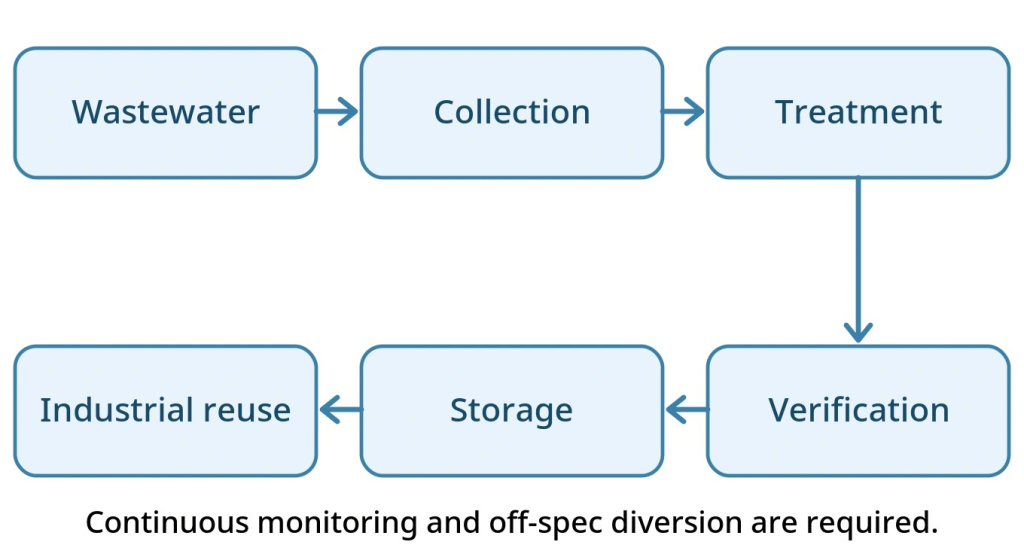
1. Identify and Collect Suitable Wastewater Streams
The first step is identifying where recoverable water originates.
Potential sources include process wastewater, equipment rinse water, treated industrial effluent and certain utility streams.
These sources should not automatically be combined. Relatively clean rinse water may require less treatment than wastewater containing oil, solvents or high concentrations of organic contaminants.
Separating streams at their source can therefore reduce treatment complexity.
Engineers also need to consider the volume and timing of wastewater generation. A process that produces wastewater intermittently may require an equalisation tank to stabilise flow before treatment.
2. Characterise Wastewater Quality
Before selecting equipment, the factory needs representative water-quality data.
Common parameters include pH, total suspended solids (TSS), chemical oxygen demand (COD), conductivity, hardness, alkalinity, silica and oil and grease.
Microbiological testing may also be important, particularly when reclaimed water will be stored, sprayed or used in systems that generate aerosols.
A single laboratory sample rarely captures the full operating picture.
Water quality can change during production shifts, cleaning cycles, maintenance activities and product changeovers. Testing should reflect these variations rather than relying solely on average conditions.
3. Select Appropriate Treatment Processes
Treatment selection depends on both the contaminants present and the quality required at the reuse point.
For example, a wastewater stream containing substantial organic matter may need biological treatment. Suspended solids may require clarification or filtration, while dissolved salts may justify membrane treatment.
A complete system may combine several technologies rather than depend on one process.
The objective is not necessarily to produce the purest possible water. It is to produce water that is consistently suitable for its intended use.
4. Verify Reclaimed-Water Quality
Treatment does not end when water leaves the final filtration unit.
The system must verify that the reclaimed water meets its defined quality requirements.
Depending on the application, this may involve online conductivity or turbidity monitoring, periodic laboratory testing and automated alarms.
If water falls outside the approved specification, the system should isolate it or redirect it through an appropriate treatment or holding route.
This protects downstream equipment from unexpected changes in water quality.
5. Store and Distribute Reclaimed Water
Reclaimed water may need dedicated storage tanks, pumps and distribution pipelines.
Storage helps balance differences between wastewater generation and reuse demand. However, poorly managed tanks can introduce new problems, including sediment accumulation and microbial growth.
Distribution systems should also prevent accidental connections between reclaimed-water pipelines and potable-water supplies.
The final design must consider storage turnover, water-quality stability, backflow prevention and equipment protection.
6. Monitor and Maintain Treatment Performance
Water recycling requires ongoing operational management.
Filters may become blocked, membrane performance may decline and chemical dosing requirements may change as wastewater characteristics fluctuate.
Operators should monitor relevant parameters, maintain instruments, inspect equipment and respond to performance trends before they become failures.
A reliable recycling system depends as much on monitoring and maintenance as it does on the treatment equipment itself.
Where Can Recycled Water Be Used in Industrial Facilities?
Industrial facilities can reuse treated water for several purposes, but each application has different quality requirements.
The suitability of a reuse application depends on how contaminants may affect equipment, product quality, worker exposure and operating reliability.
Cooling Tower Makeup Water
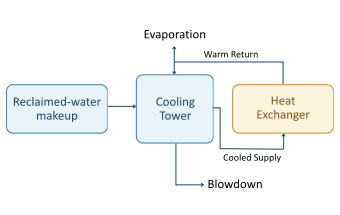
Cooling towers can be promising reuse applications because they require regular makeup water to replace evaporation, blowdown and other losses.
However, evaporation concentrates dissolved minerals in the circulating water. Excessive hardness, silica or dissolved salts can contribute to scaling, while poor biological control may create health and operational risks.
Reclaimed water therefore needs to be evaluated alongside the tower’s operating conditions, cycles of concentration and chemical treatment programme.
Factories considering this application should also review appropriate cooling tower water treatment measures.
Equipment Cleaning and Facility Washdown
Some equipment-cleaning and general washdown activities can use reclaimed water when it meets the relevant hygiene and operating requirements.
Suspended solids may block spray nozzles, while microbial growth and residual chemicals may create additional concerns.
Applications involving food-contact surfaces, sensitive materials or regulated production environments require particular care. Reclaimed water should never be assumed suitable simply because the application is described as cleaning.
Manufacturing Process Water
Certain manufacturing processes can use recycled water for rinsing, cooling or other operations.
The required treatment depends on the sensitivity of the process.
For instance, dissolved minerals that are acceptable in a general utility application may cause deposits, surface defects or product-quality problems in precision manufacturing.
Factories should establish the required water specifications before selecting a treatment system.
Boiler Makeup Water
Boiler systems may require particularly stringent control of hardness, silica, dissolved solids and other impurities.
The requirements vary with boiler pressure, equipment design and operating conditions.
Reclaimed water can potentially serve as a source of boiler makeup water, but additional polishing and chemical conditioning may be necessary.
| Reuse Application | Potential Water Source | Main Quality Concerns | Important Considerations |
|---|---|---|---|
| Cooling tower makeup | Treated effluent or suitable recovered utility water | Hardness, silica, microbiology | Scaling, corrosion and blowdown |
| Facility washdown | Appropriately treated wastewater | Solids, odour, microorganisms | Worker exposure and hygiene |
| Process rinsing | Segregated rinse streams or polished effluent | Conductivity, organics, specific ions | Product-quality requirements |
| Boiler makeup | Highly treated reclaimed water | Hardness, silica, dissolved salts | Boiler specifications and additional polishing |
| Non-potable site utilities | Suitable treated water | Suspended solids, microbial quality | Distribution and cross-connection controls |
The US EPA also identifies industrial manufacturing and cooling applications among the potential uses of appropriately treated recycled water.
Can Treated Wastewater Be Reused Directly?
Not necessarily.
One of the most important distinctions in industrial water management is that water suitable for environmental discharge is not automatically suitable for industrial reuse.
In Malaysia, industrial effluent discharge is governed by applicable environmental legislation, including the Environmental Quality (Industrial Effluents) Regulations 2009. These regulations establish requirements for relevant industrial discharges.
However, the water-quality requirements of a cooling tower, boiler or manufacturing process may involve parameters and operating limits that differ from those used to assess discharge compliance.
For example, water that meets an applicable discharge limit may still contain sufficient hardness or silica to create scaling problems in a particular cooling system.
Likewise, water with low suspended solids may still require microbiological controls before being stored and reused.
| Assessment Area | Discharge-Oriented Treatment | Reuse-Oriented Treatment |
|---|---|---|
| Primary objective | Meet applicable discharge requirements | Meet the requirements of a defined reuse application |
| Water-quality targets | Relevant legal discharge limits | Equipment, process, health and operational specifications |
| Main contaminants | Regulated discharge pollutants | Contaminants affecting reuse suitability |
| Monitoring | Compliance-related testing and controls | Application-specific quality and operational monitoring |
| Main risks | Non-compliant discharge and environmental harm | Scaling, corrosion, fouling, contamination or process disruption |
| Additional treatment | Depends on discharge requirements | Depends on the gap between existing water quality and reuse needs |
Some treated effluent may already be suitable for selected low-risk applications. Other sources require additional filtration, disinfection or advanced treatment.
The correct decision depends on testing and the intended use, not simply on whether the water has passed through a wastewater treatment plant.
Which Water Recycling Technologies Are Suitable?
There is no single treatment technology suitable for every industrial water recycling project.
Different wastewater sources contain different contaminants, and each reuse application imposes its own quality requirements.
Most industrial recycling systems therefore use a combination of processes, often called a treatment train.
Coagulation and Flocculation
Coagulation and flocculation help destabilise and aggregate suspended particles, colloids and certain emulsified contaminants so they can be separated more effectively.
These processes may be useful when wastewater contains fine particles that conventional settling or filtration cannot remove efficiently.
Their performance depends on chemical selection, dosing, pH and downstream solids separation. They also generate sludge that must be managed appropriately.
Biological Treatment, MBBR and MBR
Biological treatment uses microorganisms to break down biodegradable organic pollutants.
A moving bed biofilm reactor (MBBR) supports microbial growth on carrier media, while a membrane bioreactor (MBR) combines biological treatment with membrane separation.
MBR systems can produce low-turbidity effluent suitable for further polishing, although membrane cleaning and fouling management remain important.
The appropriate choice depends on wastewater composition, loading variability, available space and operational requirements.
Media Filtration and Ultrafiltration
Media filtration removes suspended particles and can help protect downstream equipment.
Ultrafiltration (UF) uses membranes to separate fine particles, colloids and many microorganisms, depending on membrane characteristics and system integrity.
UF is sometimes installed before reverse osmosis to reduce fouling risks.
Neither conventional media filtration nor UF should be assumed to remove dissolved salts effectively.
Reverse Osmosis
Reverse osmosis (RO) uses a pressure-driven membrane process to reduce dissolved salts and certain other dissolved contaminants.
It may be appropriate for applications requiring low conductivity or more intensive water purification.
However, RO introduces additional requirements, including suitable pretreatment, membrane maintenance, energy consumption and concentrate management.
It should be selected because the reuse application requires its capabilities, not simply because it is considered an advanced technology.
Disinfection and Chemical Conditioning
Disinfection helps manage microorganisms through methods such as ultraviolet treatment or appropriately controlled chemical dosing.
Chemical conditioning may also be needed to manage scaling, corrosion and biological activity in the receiving system.
The correct combination depends on water chemistry, storage conditions and equipment requirements.
| Technology | Main Function | Typical Role in Reuse | Important Limitation |
|---|---|---|---|
| Coagulation / flocculation | Aggregates fine particles | Pretreatment | Chemical consumption and sludge |
| Biological treatment | Reduces biodegradable pollutants | Organic removal | Sensitivity to inhibitory wastewater |
| MBBR | Biofilm-based biological treatment | Organic-load reduction | Requires downstream solids separation |
| MBR | Biological treatment with membrane separation | High-quality effluent production | Membrane fouling and maintenance |
| Media filtration | Removes suspended solids | Polishing and equipment protection | Limited dissolved-contaminant removal |
| Ultrafiltration (UF) | Removes fine particles and colloids | Advanced filtration or RO pretreatment | Does not substantially remove dissolved salts |
| Reverse osmosis (RO) | Reduces dissolved salts | High-quality polishing | Energy, pretreatment and concentrate |
| Disinfection | Controls microorganisms | Microbiological risk management | Effectiveness depends on water quality and system design |
| Chemical conditioning | Controls water chemistry | Equipment protection | Requires monitoring and correct dosing |
Insignia Water provides information about industrial wastewater treatment technologies that can be considered when evaluating treatment options.
How Much Does Industrial Water Recycling Cost in Malaysia?
The cost of industrial water recycling in Malaysia depends on the wastewater source, treatment capacity, required water quality and operating conditions.
There is no reliable universal price for a recycling system because two factories recovering the same volume of water may require very different treatment processes.
A practical cost assessment should consider both capital expenditure (CAPEX) and operating expenditure (OPEX).
Capital Expenditure
CAPEX covers the initial investment required to install and commission the system.
Typical components include treatment equipment, tanks, pumps, piping, instrumentation, electrical systems, automation and civil works.
An existing wastewater treatment plant may reduce the need for certain infrastructure, but additional polishing, storage or distribution equipment may still be required.
Operating Expenditure
OPEX includes the recurring cost of running the system.
Electricity, treatment chemicals, laboratory analysis, consumables, maintenance and labour can all contribute to operating expenses.
Membrane-based systems may also require periodic cleaning and membrane replacement.
Waste handling must be included where treatment produces sludge, spent media or concentrated reject streams.
Understanding Lifecycle Cost
The cheapest system to purchase is not necessarily the most economical system to operate.
A treatment configuration with lower initial cost may consume more chemicals or require more maintenance. Conversely, an advanced system may produce excellent water quality but be unnecessarily expensive for a relatively simple reuse application.
| Cost Driver | Why It Matters | Financial Consideration |
|---|---|---|
| Wastewater quality | Determines treatment complexity | More challenging contaminants can increase cost |
| Treatment capacity | Influences equipment sizing | Peak demand and future expansion matter |
| Water-quality target | Determines polishing requirements | Higher purity may require additional processes |
| Electricity | Powers pumps, aeration and membranes | Evaluate consumption under realistic operating conditions |
| Chemicals | Supports treatment and conditioning | Dosing varies with wastewater characteristics |
| Maintenance | Keeps equipment reliable | Include consumables, cleaning and replacements |
| Testing and monitoring | Verifies reclaimed-water quality | Include instruments, calibration and laboratory work |
| Waste management | Handles treatment residuals | Sludge and concentrate disposal can be significant |
| Storage and distribution | Delivers water to reuse points | Include tanks, pipelines and pumping |
A feasibility study should compare the full lifecycle cost of reclaimed water with the cost of the water it replaces, while considering reliability and operational risks.
Without representative site data, quoting a generic Malaysian payback period would be misleading.
How Can Factories Assess Water Recycling Feasibility?
Before investing in equipment, factories should establish whether their available wastewater can be treated and reused at an acceptable cost and operational risk.
A structured feasibility assessment helps avoid purchasing technology that does not address the facility’s actual requirements.
1. Identify Available Wastewater Streams and Volumes
Start by identifying where wastewater originates and how much is available for recovery.
Record daily and peak flow rates, operating schedules and fluctuations between production periods.
A factory producing wastewater during one shift but requiring reclaimed water throughout the day may need additional storage capacity.
The volume of recoverable wastewater must also be compared with actual reuse demand.
2. Gather Representative Water-Quality Data
Collect laboratory results that reflect normal operations and reasonably foreseeable changes.
Testing should cover parameters relevant to both the wastewater source and intended reuse application.
For example, cooling applications may require particular attention to hardness, silica, conductivity and microbiological risks.
The objective is to understand not only average water quality but also how significantly it changes.
3. Define the Intended Reuse Application
Identify exactly where the reclaimed water will be used.
A general objective such as reducing freshwater consumption is not sufficiently specific for engineering design.
The factory should determine the required water volume, acceptable water-quality limits and consequences of supplying water outside specification.
These requirements form the basis for selecting appropriate treatment technologies.
4. Review Regulatory and Operational Constraints
A feasibility assessment must consider applicable environmental requirements, workplace safety, equipment specifications and operational limitations.
Relevant Malaysian discharge requirements should be reviewed separately from the quality specifications established for internal reuse.
Facilities should also assess available installation space, electrical capacity, storage arrangements and the potential for accidental cross-connections.
5. Shortlist Suitable Treatment Approaches
Once wastewater characteristics and reuse requirements are understood, engineers can compare feasible treatment configurations.
For example, a system may require biological treatment followed by filtration and disinfection. Another application may require additional dissolved-solids removal.
Pilot testing may be valuable when wastewater characteristics are highly variable or the proposed process involves significant technical uncertainty.
Factories can review available industrial water recycling solutions when evaluating suitable approaches.
6. Compare Lifecycle Cost and Operational Reliability
Compare the total cost of producing reclaimed water against the cost of existing freshwater supply and wastewater management.
Include capital investment, electricity, chemicals, maintenance, testing, waste disposal and operational labour.
The assessment should also consider equipment downtime, spare capacity and the financial consequences of inconsistent water quality.
A project should demonstrate both technical suitability and a credible business case.
7. Establish Monitoring and Performance Verification
Define how the factory will verify water quality after commissioning.
This includes identifying critical monitoring parameters, testing frequency, responsible personnel and corrective actions.
The system should have a defined response when reclaimed water fails to meet its required specification.
Clear operating procedures and performance verification are essential for maintaining long-term reliability.
What Are the Common Challenges and Mistakes?
Industrial water recycling projects can underperform even when the selected treatment technology is technically capable of producing suitable water.
Problems often arise because the wider operating system has not been evaluated thoroughly.
Selecting treatment technology before testing wastewater is one common mistake. Without representative laboratory data, equipment may be undersized, unnecessarily complex or unsuitable for the contaminants present.
Underestimating wastewater variability can create similar problems. Production changes, cleaning chemicals and intermittent discharges may affect treatment performance.
Ignoring membrane fouling can lead to higher operating pressures, reduced output and increased maintenance. Appropriate pretreatment and monitoring are therefore important whenever membranes are used.
Poor storage and distribution design can compromise water quality after treatment. Inadequate tank turnover, biological growth and cross-connections may create risks even when the treatment plant itself operates correctly.
Insufficient monitoring can allow off-specification water to reach sensitive equipment. Automated safeguards, clear operating limits and trained personnel help reduce this risk.
Finally, unrealistic financial expectations can undermine otherwise viable projects. Reclaimed water is not free water: its production requires energy, equipment, maintenance and operational resources.
The strongest projects account for these requirements from the beginning rather than treating them as unexpected expenses after installation.
When Should a Factory Consider Water Recycling?
Water recycling deserves serious consideration when a facility has both a recoverable wastewater source and a suitable demand for reclaimed water.
Factories with substantial freshwater consumption may benefit from investigating whether some of that demand can be replaced.
However, consumption volume alone does not establish feasibility.
A factory should also consider whether wastewater is available consistently, whether suitable reuse applications exist and whether the required treatment can be operated reliably.
Water supply interruptions, production expansion and rising water-management costs may strengthen the business case.
Facilities with existing wastewater treatment infrastructure may have additional opportunities, particularly where treated effluent can be upgraded for an identified industrial application.
Nevertheless, some sites may achieve greater benefits through water conservation, leak reduction or process optimisation before investing in a dedicated recycling system.
The most appropriate starting point is therefore a water balance and feasibility assessment, not an immediate equipment purchase.
Conclusion
Industrial water recycling can help Malaysian factories reduce freshwater demand, strengthen water supply resilience and make more effective use of treated wastewater.
However, successful implementation requires more than selecting treatment equipment.
Factories must understand their wastewater characteristics, define suitable reuse applications, establish realistic water-quality requirements and evaluate the full lifecycle cost of the proposed system.
By starting with representative testing and a structured feasibility assessment, industrial facilities can identify recycling opportunities that are technically practical and economically justifiable.
Frequently Asked Questions (FAQs)
What is water recycling?
Water recycling involves collecting previously used water, treating it where necessary and reusing it for a suitable purpose. Industrial applications include cooling, equipment cleaning and selected manufacturing processes.
How does a water recycling system work?
A typical system collects wastewater, evaluates its quality, applies suitable treatment, verifies reclaimed-water quality and distributes the treated water for reuse. Monitoring and maintenance help maintain reliable performance.
Can treated industrial wastewater be reused safely?
Yes, when the treated water meets the requirements of its intended application and appropriate controls are maintained. Discharge-compliant wastewater is not automatically suitable for every reuse application.
Which industries can benefit from water recycling?
Manufacturing, electronics, food processing, chemical production and other water-intensive industries may benefit where suitable wastewater sources and reuse applications exist. Feasibility depends on site-specific conditions.
What information is needed before evaluating industrial water recycling?
Factories should prepare wastewater flow data, representative laboratory results, intended reuse applications, required water-quality specifications and existing water-management costs. These details support technology selection and financial evaluation.
Discuss Your Industrial Water Recycling Requirements
Not sure whether your treated wastewater is suitable for reuse? Contact Insignia Water to discuss your wastewater characteristics, intended reuse applications and suitable water treatment approaches.