

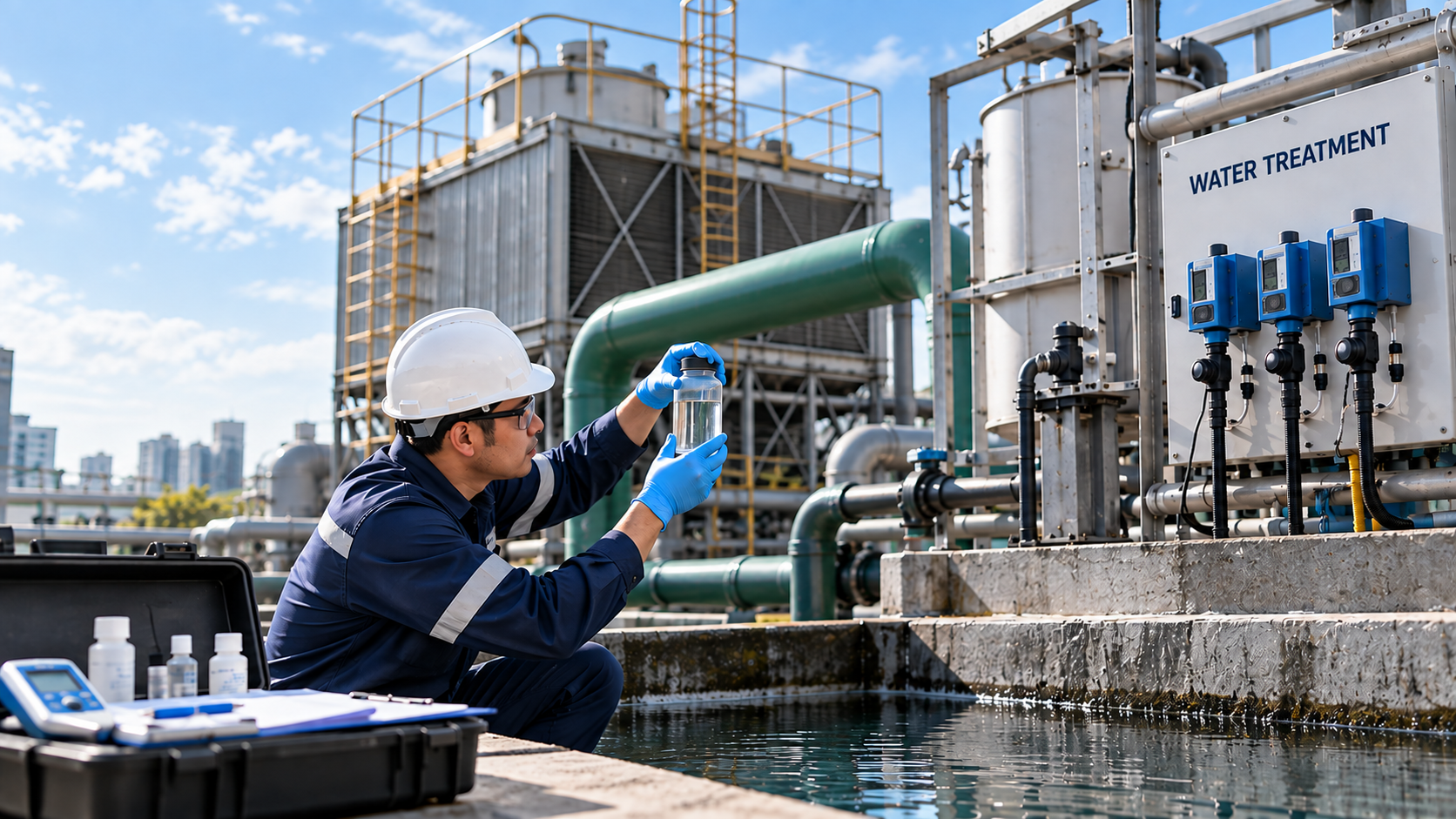
Cooling Tower Water Treatment in Malaysia: Chemicals, Monitoring & System Control
Cooling tower water treatment is essential for industrial plants and commercial facilities that depend on reliable cooling. Yet a treatment programme cannot be judged simply by whether chemicals are being added to the system.
A cooling tower continuously loses water through evaporation. As dissolved minerals become more concentrated, the risk of scale, corrosion and other water-quality problems can increase. At the same time, airborne contaminants, suspended solids and biological growth can affect system cleanliness and heat-transfer performance.
For Malaysian facilities, effective cooling tower water treatment involves selecting suitable chemicals, controlling blowdown, testing water quality and reviewing operating conditions. The objective is to keep the system within an appropriate operating range—not merely to maintain a chemical-dosing schedule.
This guide explains how these controls work together, what engineering teams should monitor and how to evaluate a cooling-water treatment programme.
Why Is Cooling Tower Water Treatment Necessary?
Cooling towers reject heat by bringing circulating water into contact with air. Some water evaporates, while the remaining water continues through the cooling system.
Evaporation removes relatively pure water, leaving most dissolved salts behind. Unless these substances are controlled, their concentration can increase as the system operates.
Four problems are particularly important.
Scale Formation
Scale develops when dissolved minerals precipitate and form deposits on equipment surfaces. Calcium carbonate is a common concern, although the actual scaling tendency depends on water chemistry, temperature and operating conditions.
Deposits on heat exchangers and condenser surfaces can interfere with heat transfer. They may also restrict water flow or create areas where other deposits accumulate.
Corrosion
Corrosion can affect carbon steel, copper alloys, galvanised components and other materials in a cooling-water circuit.
Its causes are not limited to low or high pH. Dissolved oxygen, chloride concentration, temperature, microbiological activity and incompatible treatment chemistry may all contribute.
A treatment programme must therefore consider the materials in the system as well as the water itself.
Microbiological Growth
Open cooling towers are exposed to environmental contamination and can support bacterial growth and biofilm formation.
Biofilm can contribute to fouling and make microbiological control more difficult. Cooling towers also require appropriate management of Legionella risk because contaminated aerosols can present a public-health hazard.
The CDC’s cooling tower guidance identifies cleaning, disinfectant control, sediment management and monitoring as important parts of a water-management programme.
Fouling and Suspended Solids
Dust, silt, corrosion products and biological debris can collect in the basin, piping and heat-transfer equipment.
Chemical treatment alone may not remove accumulated deposits. Depending on the system, mechanical cleaning, filtration or other corrective measures may also be necessary.
These four problems often interact. For example, deposits can create conditions that encourage localised corrosion or make microbiological control more difficult.
What Chemicals Are Used in Cooling Tower Water Treatment?
Cooling tower chemicals perform different functions. A suitable programme may combine several treatment categories rather than rely on one chemical product.
| Chemical Category | Main Purpose | What Operators Should Understand |
|---|---|---|
| Scale inhibitors | Reduce mineral precipitation and scale deposition | Selection depends on hardness, alkalinity, temperature and concentration limits. |
| Corrosion inhibitors | Help control corrosion of system metals | Compatibility with steel, copper alloys and other materials matters. |
| Oxidizing biocides | Control microbiological activity through oxidation | Effectiveness depends on the chosen chemistry, residual, pH and system conditions. |
| Non-oxidizing biocides | Provide additional microbiological control where appropriate | Application and compatibility must follow the selected treatment programme. |
| Dispersants | Help limit deposition of suspended particles and debris | They do not replace cleaning or filtration when solids accumulate. |
| pH-control chemicals | Adjust water chemistry where required | Incorrect dosing can increase corrosion, scaling or chemical-handling risks. |
There is no universally suitable chemical combination for every cooling tower.
A manufacturing facility using relatively hard make-up water may have different treatment requirements from a commercial building supplied with lower-mineral water. Systems containing mixed metals can also require additional attention to chemical compatibility.
Insignia Water’s cooling tower and chiller water treatment solutions cover scale and corrosion control, biocides, dispersants, chemical dosing and monitoring according to system requirements.
For water-treatment contractors and procurement teams, chemical selection should be supported by technical documentation, suitable application guidance and an agreed monitoring approach.
Why Is Chemical Dosing Alone Not Enough?
Chemical dosing introduces treatment products into the cooling-water system. Monitoring determines whether the treatment programme is operating as intended.
A dosing pump may be running correctly while the water chemistry is changing because of:
-
Variations in make-up water quality
-
Changes in cooling load or evaporation rate
-
Excessive or insufficient blowdown
-
Chemical-feed interruptions or incorrect pump settings
-
Leaks, overflows or uncontrolled water losses
-
Increased contamination or biological activity
Consider a cooling tower where the dosing pump operates at a fixed rate, but make-up water consumption increases significantly during a period of higher cooling demand.
The amount of chemical entering the system may no longer be appropriate relative to the amount of water being replaced. Without testing or suitable feed controls, the operator may not recognise the change.
The reverse is also possible. Excessive dosing can waste chemicals and, depending on the product, create compatibility or operating problems.
This is why chemical dosing should be linked to water-quality targets, system operation and regular verification.
The U.S. Department of Energy’s cooling tower management guidance recommends conductivity control, flow monitoring, recordkeeping and routine review of water-treatment performance.
What Water Parameters Should Be Monitored?
Cooling tower water testing should focus on parameters that influence the actual risks and treatment objectives of the system.
| Parameter | Why It Matters | How the Result Is Used |
|---|---|---|
| pH | Influences corrosion, scaling and certain chemical-treatment reactions | Assess chemistry against the approved treatment programme. |
| Conductivity | Indicates the concentration of dissolved ionic substances | Support blowdown control and concentration tracking. |
| Calcium hardness and alkalinity | Help assess mineral scaling tendency | Review scale-control requirements alongside temperature and other chemistry. |
| Chloride and other relevant dissolved constituents | Can influence corrosion and concentration limits | Evaluate material compatibility and operating limits. |
| Treatment-inhibitor residual | Indicates the measured level of selected treatment chemistry | Check whether the inhibitor remains within its specified control range. |
| Biocide or disinfectant residual | Helps assess chemical availability for microbiological control | Verify the programme using the correct test for the selected chemistry. |
| Microbiological indicators | Provide information about biological control | Investigate adverse trends and review cleaning or treatment requirements. |
| Temperature and operating conditions | Affect scaling, microbiological activity and treatment performance | Interpret water-test results in their operating context. |
Not every parameter requires continuous online measurement. Some can be measured using field instruments, while others may require laboratory analysis.
The appropriate testing frequency and acceptable limits must be established for the specific system. A universal pH or conductivity target should not be copied from another facility without checking its make-up water, equipment materials and treatment programme.
Why Trends Matter More Than One Test Result
A single water sample provides information about the system at a particular moment.
Repeated measurements help identify whether the system is moving towards an operating limit or whether a change has occurred.
For example, a steady rise in conductivity may indicate increasing dissolved-solids concentration. However, the correct response depends on the make-up water conductivity, controller settings, blowdown operation and other conditions.
Similarly, a change in microbiological test results should prompt investigation rather than an automatic, unverified increase in biocide dosage.
Facilities needing additional guidance on sampling and interpreting results can refer to Insignia Water’s industrial water testing guide.
How Do Blowdown and Cycles of Concentration Affect Treatment?
Blowdown is the controlled discharge of circulating cooling water to limit the accumulation of dissolved substances. Fresh make-up water replaces the water lost through blowdown, evaporation and other losses.
Too much blowdown can waste water and treatment chemicals. Too little blowdown may allow dissolved constituents to rise beyond acceptable limits.
A useful operating measure is the cycles of concentration, which compares the concentration of a suitable dissolved constituent in circulating water with its concentration in make-up water.
For an initial estimate, conductivity is commonly used:
Estimated cycles of concentration = Circulating-water conductivity ÷ Make-up-water conductivity
Example: Estimating Cooling Tower Cycles
Suppose a cooling tower has the following readings:
| Measurement | Example Reading |
|---|---|
| Make-up water conductivity | 300 µS/cm |
| Circulating water conductivity | 1,200 µS/cm |
| Estimated cycles of concentration | 4 |
Calculation: 1,200 ÷ 300 = 4 cycles
This suggests the circulating water has approximately four times the conductivity of the make-up water.
However, conductivity is an indicator rather than a complete chemical analysis. The estimate can be affected by chemical additions, water blending and other dissolved constituents. Where necessary, operators should confirm the result using an appropriate conservative tracer and water-balance information.
Four cycles is not automatically the correct operating target. The allowable concentration depends on factors including scaling tendency, corrosion risks, treatment chemistry and equipment requirements.
The DOE guidance on cooling tower management recommends improving cycles of concentration only within the limits supported by water quality and treatment performance.
Why Automatic Blowdown Control Helps
A conductivity controller can measure circulating-water conductivity and operate a blowdown valve when a programmed limit is reached.
This can provide more consistent control than relying entirely on manual blowdown, provided the instrument is calibrated, the probe is maintained and the control settings are appropriate.
Automatic blowdown does not eliminate the need for water testing. Conductivity cannot independently confirm corrosion inhibition, microbiological control or the absence of deposits.
How Should Cooling Tower Chemical Dosing Be Controlled?
Chemical dosing arrangements vary according to system size, chemical type and operating conditions.
Some systems use manually adjusted dosing pumps. Others use automated equipment linked to make-up water flow, chemical residual or other measurements.
The correct arrangement depends on what the chemical is intended to control.
For example, a treatment inhibitor may be dosed in relation to make-up water consumption or a validated control measurement. A biocide programme may require a different dosing and verification approach.
Where automatic dosing is installed, operators should still check that the equipment is functioning correctly.
Important considerations include chemical-tank levels, pump operation, injection-point suitability, instrument calibration, controller alarms and actual water-test results.
Automated equipment should also incorporate appropriate safeguards for the chemicals being handled. Acid and biocide systems, in particular, require careful consideration of chemical compatibility, safe handling and the consequences of incorrect dosing.
A well-designed controller improves consistency, but it cannot compensate for an unsuitable treatment programme or neglected maintenance.
Cooling Tower Water Treatment Troubleshooting: What Should Operators Check?
When a cooling tower develops a problem, the most useful first step is to identify what has changed.
| Observed Problem | Possible Contributing Factors | Recommended Investigation |
|---|---|---|
| Scale or mineral deposits | Elevated scaling tendency, inadequate inhibitor control, unsuitable concentration limits | Review make-up and circulating-water chemistry, temperature, inhibitor results and blowdown settings. |
| Corrosion or metal loss | Unsuitable chemistry, inhibitor deficiency, incompatible materials, deposits or microbiological effects | Inspect affected materials and review corrosion indicators, treatment records and system conditions. |
| Slime or biological fouling | Inadequate microbiological control, stagnant areas, accumulated deposits | Review cleaning, circulation, microbiological monitoring and the biocide programme. |
| High water consumption | Excessive blowdown, leaks, overflow or controller problems | Compare make-up and blowdown meter readings; inspect valves and basin-level controls. |
| Unstable conductivity | Changing make-up quality, controller faults, irregular blowdown | Verify probe calibration, sampling location, valve operation and recent operating changes. |
| Reduced heat-transfer performance | Scale, fouling, airflow restrictions or other equipment issues | Investigate both water-side deposits and mechanical operating conditions. |
These are possible causes, not confirmed diagnoses. Several problems can produce similar symptoms.
For example, declining heat-transfer performance should not automatically be attributed to scale. Mechanical issues, airflow conditions and equipment fouling may also need investigation.
Where a significant microbiological or public-health concern is suspected, the facility should follow its water-management and escalation procedures and obtain appropriate specialist advice.
Cooling Tower Water Treatment and Legionella Risk
Microbiological control deserves particular attention because cooling towers can generate aerosols.
Legionella bacteria may grow under favourable conditions, especially where biofilm, sediment, stagnation or inadequate disinfectant control is present.
A water-treatment programme can help manage these conditions, but routine chemical dosing alone does not establish that a cooling tower is free from Legionella risk.
The CDC recommends a structured water-management programme covering operational controls, cleaning, disinfection, monitoring, documentation and corrective action.
For Malaysian facility managers, the practical lesson is to coordinate cooling-water treatment with site safety procedures, equipment maintenance and applicable local requirements.
The programme should clearly define who reviews results, what conditions trigger action and how corrective measures are documented.
How Often Should Cooling Tower Water Be Tested?
There is no single testing frequency suitable for every cooling tower.
A continuously operating industrial system with changing water quality may require a different monitoring schedule from a smaller, stable installation.
Testing frequency should reflect the system’s risk profile, treatment chemistry, operating history, instrumentation and the consequences of treatment failure.
A practical monitoring plan normally distinguishes between three activities:
Routine operational checks examine the condition of the cooling tower, chemical-feed equipment, controller readings and any visible signs of abnormal operation.
Scheduled water testing measures the parameters needed to verify chemical control, concentration limits and microbiological management.
Periodic technical reviews assess trends, equipment condition, water consumption and whether the current treatment programme remains appropriate.
Additional testing may be needed after major maintenance, changes in water supply, prolonged shutdowns, unusual test results or other significant operating changes.
The CDC’s cooling tower control guidance recommends adjusting monitoring frequency according to system conditions and the stability of control measurements.
What Should Malaysian Facilities Look for in a Cooling Tower Treatment Supplier?
For plant managers, maintenance engineers and procurement teams, supplier selection should involve more than comparing chemical prices.
The real question is whether the proposed programme can control the relevant risks while remaining practical to operate.
1. Does the Supplier Assess the Actual Cooling System?
A supplier should understand the system’s configuration, water source, operating load, equipment materials and existing treatment arrangements before recommending a programme.
2. Are the Chemical Functions and Control Requirements Clear?
The proposal should identify the intended purpose of each treatment product, relevant compatibility considerations and how the programme will be verified.
Buyers should request applicable technical and safety documentation.
3. Is Water Testing Included?
A treatment proposal should explain which parameters will be measured, how often testing will take place and how results will be reported.
A list of chemicals without a monitoring plan gives the facility limited information about ongoing treatment performance.
4. How Are Dosing and Blowdown Managed?
Ask whether chemical dosing will be manual, flow-related or controlled using measured parameters.
The supplier should also explain how conductivity and blowdown settings will be established and reviewed.
5. What Happens When Results Fall Outside the Control Range?
A useful treatment programme should define how abnormal results are investigated and who is responsible for recommending corrective action.
This is particularly important where water quality or operating loads change frequently.
6. How Will Treatment Performance Be Reported?
Service reports should help the facility understand trends, chemical consumption, water use, identified risks and recommended actions.
For procurement teams, this provides a more meaningful basis for comparing treatment proposals than price per container alone.
The DOE’s cooling tower guidance similarly recommends evaluating suppliers using treatment costs, water efficiency and regular service reporting rather than focusing exclusively on chemical purchases.
What Information Should You Prepare Before Requesting a Treatment Proposal?
A more complete enquiry helps a water-treatment specialist assess the application and recommend an appropriate next step.
Where available, prepare the following information:
| Information | Why It Helps |
|---|---|
| Cooling tower type and system arrangement | Identifies whether the application is open recirculating, closed-loop or a combination. |
| Cooling capacity and operating schedule | Provides context for water demand and changing cooling loads. |
| Make-up water source and recent analysis | Helps identify scaling, corrosion and concentration concerns. |
| System materials | Supports chemical-compatibility assessment. |
| Existing chemicals and dosing equipment | Helps evaluate the current programme and possible changes. |
| Water-testing records | Reveals historical operating conditions and trends. |
| Make-up and blowdown meter readings | Supports water-balance and concentration review. |
| Current problems or maintenance history | Helps prioritise investigation and corrective action. |
Not every facility will have all this information available. Missing records can also help identify where a baseline assessment is needed.
Cooling Tower Treatment vs Chiller Water Treatment: Are They the Same?
Cooling tower and chiller water treatment are related, but they should not be treated as identical applications.
An open cooling tower is exposed to the atmosphere and loses water through evaporation. This creates concentration and contamination challenges that require ongoing attention.
A closed chilled-water circuit generally has different operating conditions, including reduced direct exposure to the atmosphere and different water-loss patterns.
However, closed-loop systems can still experience corrosion, fouling or microbiological problems, especially where make-up water enters, air is present or maintenance conditions are poor.
Treatment must therefore reflect the actual circuit rather than applying an open-tower chemical programme to every part of the cooling system.
For a closer look at these differences, see Insignia Water’s guide to chiller water treatment and efficiency.
Building a More Reliable Cooling Tower Water Treatment Programme
A reliable programme starts with the cooling system itself.
The facility needs to understand its water source, equipment materials, operating conditions and treatment risks. Chemical products are then selected to address those requirements.
Monitoring confirms whether the programme remains within its intended control conditions. Blowdown management helps control dissolved-solids concentration, while routine inspection and cleaning address problems that chemical treatment cannot solve on its own.
The result is a more informed approach to cooling-water management, with better visibility of treatment performance and clearer decisions when conditions change.
For Malaysian industrial and commercial facilities, this is the value of treating cooling tower water management as an ongoing operational responsibility rather than a routine chemical purchase.
Frequently Asked Questions (FAQs)
What is cooling tower water treatment?
Cooling tower water treatment is the management of circulating water to control scale, corrosion, fouling and microbiological growth. A programme may combine treatment chemicals, blowdown control, water testing, monitoring and equipment maintenance.
What chemicals are used in cooling tower water treatment in Malaysia?
Common treatment categories include scale inhibitors, corrosion inhibitors, oxidizing and non-oxidizing biocides, and dispersants. The appropriate products depend on the cooling system, water quality, equipment materials and treatment objectives.
How do you control scale in a cooling tower?
Scale control involves evaluating make-up water chemistry, managing cycles of concentration, maintaining suitable treatment-inhibitor levels and controlling operating conditions. Existing deposits may require additional investigation or cleaning.
What is the purpose of cooling tower blowdown?
Blowdown removes a portion of concentrated circulating water so dissolved substances do not accumulate beyond acceptable limits. It helps manage scaling and corrosion risks, but excessive blowdown can waste water and treatment chemicals.
How often should cooling tower water be tested?
Testing frequency depends on system conditions, operating stability, treatment chemistry and the facility’s water-management programme. Some parameters may be monitored continuously, while others require scheduled field or laboratory testing.
Can automatic chemical dosing replace manual water testing?
No. Automated dosing can improve consistency, but sensors, pumps and controllers still require verification and maintenance. Laboratory or field testing may also be necessary to assess parameters that the installed instruments do not measure.
How can I choose a cooling tower water treatment supplier in Malaysia?
Look for a supplier that assesses your system, explains its chemical selection, provides a clear testing and monitoring plan, and supports corrective action when results change. Compare the overall treatment programme and service scope, not just chemical prices.
Need Cooling Tower Water Treatment Support in Malaysia?
Whether you are reviewing an existing treatment programme, dealing with recurring scale or corrosion, or planning improved water-quality monitoring, the first step is to understand your system and its current conditions.
Discuss Your Cooling Tower Water Treatment Requirements with Insignia Water
You can also contact Insignia Water to discuss your application and arrange an appropriate assessment.