

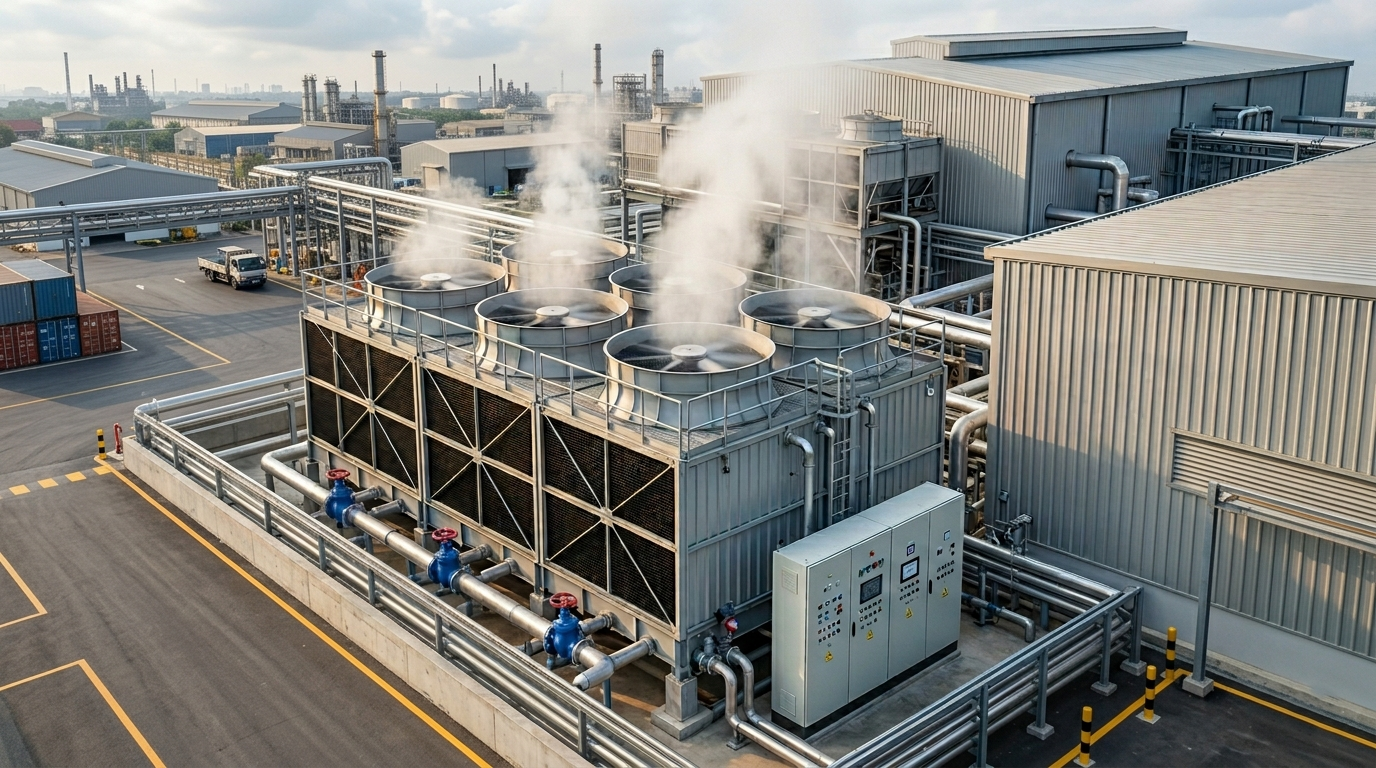
How to Optimise Cooling Tower and Chiller Water Treatment in Malaysia to Reduce Scaling, Corrosion and Energy Loss
Optimising cooling water chemical treatment, cooling tower water treatment Malaysia and chiller water treatment requires precise control of water chemistry, system operation and dosing accuracy.
In Malaysia’s tropical climate, high ambient temperature and humidity increase evaporation rates and biological activity. This accelerates scaling, corrosion and microbial growth in cooling systems.
According to ASHRAE HVAC guidelines, poor water quality in evaporative systems leads directly to:
- scaling from concentrated dissolved solids
- corrosion due to unstable chemistry
- biological contamination including bacteria and algae
Without optimisation, these issues reduce heat transfer efficiency, increase energy consumption and shorten equipment life.
What Optimisation Means in Cooling Water Treatment
Optimising cooling water chemical treatment, cooling tower water treatment Malaysia and chiller water treatment requires precise control of water chemistry, system operation and dosing accuracy.
In Malaysia’s tropical climate, high ambient temperature and humidity increase evaporation rates and biological activity. This accelerates scaling, corrosion and microbial growth in cooling systems.
According to ASHRAE HVAC guidelines, poor water quality in evaporative systems leads directly to:
- scaling from concentrated dissolved solids
- corrosion due to unstable chemistry
- biological contamination including bacteria and algae
Without optimisation, these issues reduce heat transfer efficiency, increase energy consumption and shorten equipment life.
Applicable Standards and Guidelines in Malaysia
Industrial water treatment practices in Malaysia generally follow international HVAC and water safety standards, including:

ASHRAE Standards and Guidelines
- ASHRAE Handbook HVAC Applications
- ASHRAE Standard 188 for Legionella risk management
- ASHRAE Guideline 12 for minimising microbial contamination
These standards require:
- control of biological growth in all cooling towers
- proper water treatment to prevent scale and corrosion
routine monitoring and maintenance programmes
Malaysian Regulatory Context
While Malaysia does not have a single unified cooling tower water treatment standard, compliance typically aligns with:
- Department of Occupational Safety and Health (DOSH) requirements for safe plant operation
- Department of Environment (DOE) regulations for water discharge and chemical handling
- Industry adoption of ASHRAE and CTI best practices
This means optimisation must consider:
- environmental discharge limits
- safe chemical usage
- system reliability and worker safety
Why Optimisation Matters: Measurable Impact
Cooling system efficiency is highly sensitive to surface condition.
- Industry studies show 1 mm of scale can increase energy consumption by approximately 10 to 15 percent due to reduced heat transfer
- Deposits increase thermal resistance, forcing compressors and pumps to work harder
ASHRAE also confirms that accumulated contaminants and fouling increase maintenance requirements and reduce system life.
In Malaysia, where cooling systems often operate continuously, these inefficiencies translate directly into higher operating cost.
Optimising Cooling Tower Water Treatment Malaysia
Control Cycles of Concentration Without Triggering Scale
Cooling towers concentrate dissolved solids due to evaporation.
ASHRAE states that impurities increase rapidly in evaporative systems and must be controlled to prevent scaling and deposits.
Optimisation approach:
- determine maximum allowable cycles based on:
- hardness
- alkalinity
- silica
- use conductivity-based automatic blowdown
- apply scale inhibitors to stabilise minerals
Balanced control reduces both scaling risk and water waste.
Fine-Tune Chemical Dosing Based on Real Demand
Cooling tower load varies with:
- ambient temperature
- production demand
- system usage
Fixed dosing leads to inefficiency.
Optimised approach:
- proportional dosing linked to make-up water or load
- continuous monitoring of:
- pH
- conductivity
- adjustment based on system response
Maintaining near-neutral and stable water chemistry is critical to prevent both corrosion and scaling.
Strengthen Biofouling Control in Tropical Conditions
ASHRAE requires all cooling towers to be treated to control biological growth, including bacteria such as Legionella
Malaysia’s warm conditions accelerate microbial growth.
Optimisation strategy:
- alternate oxidising and non-oxidising biocides
- maintain effective dosing intervals
- ensure proper chemical distribution
Uncontrolled biofilm reduces heat transfer and increases system resistance.
Optimising Chiller Water Treatment for Closed-Loop Stability
Maintain Stable Water Chemistry
Closed-loop systems require long-term stability.
Optimisation actions:
- maintain stable pH within recommended range
- apply corrosion inhibitors suited to system materials
- minimise oxygen ingress
Unlike open systems, closed loops require consistency rather than frequent adjustment.
Minimise Unnecessary Chemical Use
Closed systems typically require:
- correct initial dosing
- periodic monitoring
- targeted correction
Excess chemical addition can destabilise the system and increase cost.
Monitor System Integrity
Closed-loop systems can still experience:
- leaks
- contamination
- maintenance issues
Monitoring ensures early detection and prevents system degradation.
Reducing Energy Loss Through Water Treatment Optimisation
Eliminate Scale
Scale reduces heat transfer efficiency and increases energy demand.
Even thin deposits create thermal resistance, increasing compressor load.
Maintain Clean Heat Transfer Surfaces
ASHRAE highlights that sediment, corrosion and biological growth reduce system performance and increase maintenance requirements.
Optimisation requires:
- consistent chemical treatment
- filtration where needed
- routine inspection
Align Treatment with System Load
Cooling demand fluctuates.
Optimised systems:
- adjust dosing dynamically
- maintain stable chemistry under varying load
- avoid overdosing during low demand
Common Gaps That Prevent Optimisation
Treating Symptoms Instead of Root Causes
Increasing chemical dosage without addressing system control or design issues leads to higher cost without solving the problem.
Lack of Integration Between Chemical and Mechanical Systems
Water treatment must align with system operation for consistent results.
Limited Monitoring
Manual testing alone may not respond quickly to system changes. Real-time monitoring improves control, especially in industrial systems.
Why Integrated Solutions Deliver Better Results
Effective optimisation requires coordination between:
- chemical treatment
- dosing systems
- monitoring tools
ASHRAE emphasises that water treatment alone cannot compensate for poor maintenance or system conditions.
Integrated systems enable:
- accurate dosing
- stable water chemistry
- continuous performance improvement
Practical Optimisation Workflow
Step 1: Establish Baseline
Measure:
- energy consumption
- water quality
- system performance
Step 2: Identify Issues
Check for:
- scaling
- corrosion
- unstable operation
Step 3: Optimise Treatment
Adjust:
- chemical selection
- dosing rates
- control strategy
Step 4: Implement Monitoring
Use sensors and controllers for consistent operation.
Step 5: Continuous Improvement
Review performance regularly to maintain efficiency and reduce cost.
Conclusion
Optimising cooling water chemical treatment, cooling tower water treatment Malaysia and chiller water treatment requires a structured, standards-aligned approach.
By:
- maintaining stable water chemistry
- improving dosing accuracy
- implementing monitoring systems
industrial facilities can reduce:
- scaling
- corrosion
- energy loss
Following recognised standards such as ASHRAE and aligning with Malaysian regulatory requirements ensures systems operate efficiently, safely and sustainably over the long term.
Frequently Asked Questions (FAQs)
What is cooling water chemical treatment and why is it important?
Cooling water chemical treatment involves controlling scale, corrosion and microbial growth in cooling systems through carefully selected chemicals and monitoring. Without proper treatment, deposits and fouling reduce heat transfer efficiency, increasing energy consumption and equipment wear, especially in continuously operating industrial systems.
How does cooling tower water treatment Malaysia differ from other regions?
Cooling tower water treatment Malaysia must address higher temperatures, humidity and biological activity. These conditions accelerate scaling and microbial growth, requiring stronger biocide control and tighter monitoring of water chemistry compared to temperate climates where biological risks and evaporation rates are lower.
How often should chiller water treatment be monitored in a closed-loop system?
Chiller water treatment systems typically require periodic monitoring rather than continuous chemical dosing. Industry practice recommends routine checks of pH, inhibitor levels and system integrity to maintain stable conditions, since closed-loop systems are less exposed to contamination but still vulnerable to corrosion if left unchecked.
Can poor cooling water chemical treatment increase energy costs significantly?
Yes. Even thin layers of scale or biofilm reduce heat transfer efficiency. Studies show that around 1 mm of scale can increase energy consumption by about 10 to 15 percent, as chillers and cooling systems must work harder to maintain the same cooling capacity.
What are the signs that cooling tower water treatment Malaysia is not optimised?
Common signs include recurring scaling, corrosion, biofilm buildup, unstable water chemistry and increased energy usage. Frequent chemical adjustments or inconsistent system performance also indicate poor optimisation, often caused by lack of monitoring, incorrect dosing strategies or imbalance between system operation and treatment programme.