

Wastewater Treatment in Malaysia: A Beginner's Guide to Processes & Systems
Wastewater treatment is an important part of operating an industrial or commercial facility in Malaysia. Water used for manufacturing, cleaning, processing or other activities may contain contaminants that must be removed or controlled before discharge.
But wastewater treatment is not simply a matter of installing a filtration system or adding chemicals.
The appropriate treatment process depends on what is in the wastewater, how much is generated, where the treated water will go and which requirements apply to the facility.
For example, wastewater from food processing may contain high levels of biodegradable organic matter, while wastewater from metal finishing may require treatment for metals and other chemical contaminants. These two applications cannot automatically use the same treatment process.
This beginner’s guide explains how wastewater treatment works in Malaysia, the main treatment stages, common technologies, regulatory considerations and what businesses should know before selecting a wastewater treatment system.
What Is Wastewater Treatment?
Wastewater treatment is the process of removing or reducing contaminants from used water so that the treated water can meet its intended discharge or reuse requirements.
Wastewater can contain suspended solids, dissolved organic matter, oils, chemicals, nutrients, metals and microorganisms. The type and concentration of these contaminants depend on where the water comes from.
A wastewater treatment plant may use physical, chemical and biological processes to reduce these contaminants.
The treated water is often called treated effluent. Depending on its quality and applicable requirements, it may be discharged through an authorised route or undergo further treatment for a suitable reuse application.
What Is the Difference Between Wastewater, Effluent and Sewage?
These terms are related, but they do not always mean the same thing.
| Term | Meaning | Example |
|---|---|---|
| Wastewater | A broad term for water affected by domestic, commercial or industrial use. | Used water from washing, manufacturing or food processing. |
| Industrial effluent | Liquid waste or wastewater associated with industrial activities, subject to the applicable regulatory definitions. | Wastewater discharged from an industrial production process. |
| Sewage | Wastewater associated primarily with sanitary and domestic activities. | Wastewater from toilets and other sanitary facilities. |
| Treated effluent | Wastewater that has passed through treatment processes. | Water leaving an industrial effluent treatment system after treatment. |
The distinction matters because industrial effluent and sewage may be subject to different Malaysian regulatory requirements.
For an industrial facility, understanding the source and classification of its wastewater is an essential first step.
Why Is Wastewater Treatment Important in Malaysia?
Malaysian industries generate wastewater from many different operations, including food manufacturing, chemical processing, metal finishing, cleaning and equipment maintenance.
Without suitable treatment and management, contaminated wastewater can affect rivers, aquatic ecosystems and downstream water users.
Wastewater treatment serves several purposes.
Environmental Protection
Treatment reduces the amount of pollutants entering receiving waters. Depending on the wastewater, this may involve removing suspended solids, biodegradable organic matter, oils, nutrients or specific chemical contaminants.
Regulatory Compliance
Facilities must determine which environmental requirements apply to their activities and discharge arrangements.
For relevant industrial effluent discharges, Malaysia’s Department of Environment (DOE) administers requirements under the Environmental Quality Act 1974 and the Environmental Quality (Industrial Effluent) Regulations 2009.
Compliance requires more than achieving a satisfactory result on one water sample. Treatment system operation, monitoring, recordkeeping and other regulatory duties may also apply.
Operational Reliability
An unsuitable or poorly maintained wastewater treatment system can create problems such as sludge accumulation, unstable treatment performance, odour complaints or unexpected maintenance requirements.
A properly managed system helps operators identify problems before they become more serious.
Water Conservation and Reuse
Some treated wastewater can undergo additional treatment for appropriate non-potable uses, reducing the need for fresh make-up water.
However, water that meets a discharge requirement is not automatically suitable for every reuse application. Reuse quality must be assessed against the intended use.
For more on this distinction, see Insignia Water’s water recycling guide for Malaysia.
How Does the Wastewater Treatment Process Work?
Wastewater treatment usually involves several processes working together. The sequence depends on the wastewater characteristics and the quality required at the outlet.
A simplified industrial wastewater treatment process may look like this:
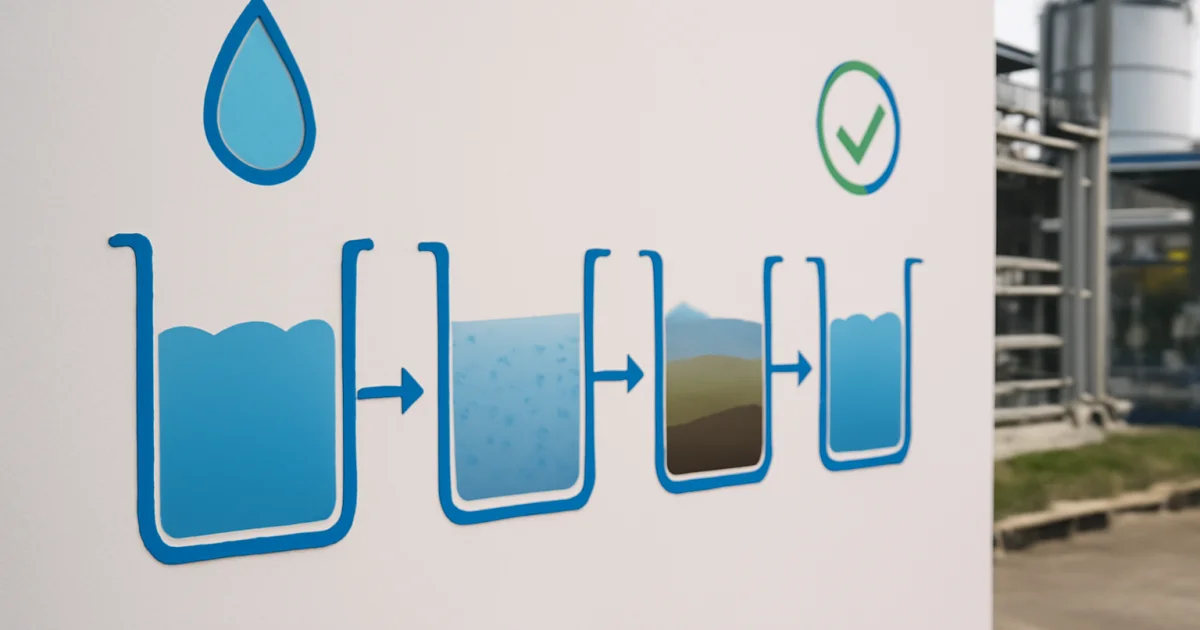
Wastewater Collection → Screening → Equalisation → Physical/Chemical Treatment → Biological Treatment → Clarification → Final Treatment → Discharge or Reuse
Sludge generated during treatment must also be collected and managed appropriately.
This is an illustrative process, not a compulsory sequence for every plant. Some systems do not require biological treatment; others need specialised processes or additional treatment stages.
1. Preliminary Treatment: Removing Large Solids
Preliminary treatment protects downstream equipment by removing materials that could obstruct pumps, pipes or treatment units.
Depending on the application, it may include screens, strainers, grit removal or oil separation.
For example, wastewater containing food scraps or packaging debris may need screening before entering subsequent treatment stages.
2. Equalisation: Managing Changes in Wastewater
Industrial wastewater flow and composition can vary throughout the day.
A factory may discharge relatively clean wash water at one point and more concentrated wastewater during another production activity.
An equalisation tank helps reduce these fluctuations by collecting and mixing wastewater before downstream treatment.
This can make the incoming flow and contaminant load more manageable.
Equalisation does not necessarily remove contaminants. Its main purpose is to stabilise the conditions entering later treatment stages.
3. Primary and Physicochemical Treatment
Primary treatment separates contaminants using physical or chemical processes.
Sedimentation allows settleable solids to collect at the bottom of a tank. Flotation can help separate materials such as oils or suspended particles.
Where fine particles do not separate easily, chemical treatment may be needed.
Coagulation destabilises particles so they can come together. Flocculation encourages the formation of larger flocs that can be removed by settling or other separation methods.
Chemical selection and dosage depend on wastewater characteristics. Jar testing may help evaluate suitable treatment conditions before full-scale application.
4. Secondary Treatment: Removing Biodegradable Organic Matter
Secondary treatment commonly uses microorganisms to break down biodegradable organic pollutants.
Biological treatment is particularly relevant where wastewater contains organic matter that microorganisms can use as a food source.
Common biological treatment technologies include:
-
Activated sludge systems
-
Sequencing batch reactors (SBR)
-
Moving bed biofilm reactors (MBBR)
-
Membrane bioreactors (MBR)
These technologies are not interchangeable in every application.
Their suitability depends on organic loading, wastewater variability, available space, operating requirements and the required effluent quality.
How Does MBBR Wastewater Treatment Work?
A Moving Bed Biofilm Reactor uses carrier media that provide surfaces for microorganisms to grow.
As wastewater moves through the reactor, the microorganisms in the biofilm break down biodegradable organic matter under suitable conditions.
Aerobic MBBR systems require adequate oxygen and appropriate operating conditions to support biological activity.
Insignia Water’s wastewater treatment technology includes an MBBR-based approach that can be integrated with equalisation, coagulation, flocculation, clarification and monitoring.
MBBR is a biological treatment process—not automatically a complete treatment plant by itself. Other stages may still be needed.
5. Clarification and Solids Separation
After chemical or biological treatment, suspended solids may need to be separated from the treated water.
Clarifiers allow settleable solids to collect for removal, while the clarified water continues to the next stage.
The solids generated during treatment form part of the plant’s sludge-handling requirements.
Poor solids separation can affect final effluent quality even when the preceding treatment process is functioning.
6. Tertiary and Advanced Treatment
Some wastewater requires additional treatment after the main physical, chemical or biological stages.
Possible technologies include sand filtration, activated carbon, membrane filtration, disinfection or specialised processes for particular contaminants.
These stages are selected according to the remaining pollutants and the required water quality.
For example, water intended for certain reuse applications may need additional filtration or other treatment beyond what is necessary for an authorised discharge.
The selection should be based on the actual water-quality requirement rather than assuming that more advanced technology is always better.
What Are the Common Wastewater Treatment Technologies in Malaysia?
There is no single best wastewater treatment technology for every facility.
The main treatment methods are usually grouped into physical, chemical and biological processes, with advanced technologies added when needed.
| Treatment Technology | Main Function | Important Consideration |
|---|---|---|
| Screening and sedimentation | Remove debris and settleable solids. | Do not adequately remove all dissolved contaminants. |
| Coagulation and flocculation | Help separate suspended and colloidal particles. | Require appropriate chemical selection, dosing and solids removal. |
| Biological treatment | Break down biodegradable organic matter. | Performance depends on wastewater biodegradability and biological operating conditions. |
| Membrane filtration | Separate contaminants according to membrane type and pore size or separation mechanism. | Fouling, pretreatment and maintenance must be considered. |
| Activated carbon | Adsorb selected dissolved contaminants. | Capacity and suitability depend on the contaminants present. |
| Disinfection | Reduce targeted microorganisms where required. | Does not replace treatment for solids, organic loading or dissolved chemicals. |
A facility may combine several of these technologies.
For instance, a treatment system might use equalisation and coagulation to manage suspended contaminants before biological treatment reduces biodegradable organic matter.
The treated water may then pass through clarification and additional polishing if required.
The important question is not which technology sounds most advanced, but which combination can treat the actual wastewater to the required quality.
Which Wastewater Parameters Should Be Tested?
Water testing helps determine what treatment is needed and whether the system is performing as intended.
The most useful parameters depend on the wastewater source and treatment objectives.
| Parameter | What It Indicates | Why It Matters |
|---|---|---|
| pH | Acidity or alkalinity. | Affects chemical treatment, biological processes and discharge assessment. |
| Biochemical Oxygen Demand (BOD) | Oxygen demand associated with biodegradable organic matter under the test conditions. | Helps evaluate biodegradable organic pollution and treatment performance. |
| Chemical Oxygen Demand (COD) | Oxygen equivalent of substances oxidised by the specified chemical test. | Helps assess overall oxidisable loading and treatment changes. |
| Total Suspended Solids (TSS) | Suspended particulate matter. | Indicates solids-separation performance. |
| Oil and grease | Oil-based contamination. | Can affect separation equipment and downstream treatment. |
| Ammoniacal nitrogen | A form of nitrogen present in wastewater. | May require specific biological or other treatment depending on requirements. |
| Metals or specific chemicals | Contaminants associated with particular industrial processes. | May require specialised treatment and testing. |
Testing should begin with a representative understanding of the wastewater, not just a single convenient sample.
For example, a factory’s wastewater may change between production, equipment washing and cleaning operations. Sampling only during a low-load period may fail to capture conditions the treatment plant must handle.
Insignia Water’s industrial water testing guide explains the broader role of testing and monitoring in industrial water management.
What Are Malaysia's Wastewater Treatment Regulations?
Industrial wastewater treatment in Malaysia must be considered alongside the applicable environmental requirements.
For industrial effluent covered by the relevant framework, a key regulation is the Environmental Quality (Industrial Effluent) Regulations 2009, administered by the Department of Environment (DOE).
The regulations address matters including treatment system design and operation, effluent monitoring, competent personnel, discharge conditions, sampling and recordkeeping.
Facilities should consult the official DOE industrial effluent regulations when determining their obligations.
What Are Standard A and Standard B?
Standard A and Standard B refer to different discharge conditions specified under Malaysia’s industrial effluent regulatory framework.
The applicable standard depends on the discharge circumstances and regulatory provisions. A facility should not choose between them based solely on which set of limits is easier to achieve.
Different parameters may have different limits, and certain industrial activities may be governed by additional or separate requirements.
The DOE’s Environmental Requirements: A Guide for Investors reproduces relevant discharge conditions and provides useful background. However, the applicable regulations and any subsequent amendments remain the appropriate legal references.
Is Meeting a Discharge Limit Enough?
Not necessarily.
A treatment system may produce a compliant sample on one occasion while still experiencing unstable operation, inadequate monitoring or other compliance problems.
Operators also need to understand applicable requirements for treatment system operation, performance monitoring, sampling, reporting and other duties.
Malaysia’s DOE publishes industrial guidance documents covering industrial effluent characterisation and treatment-system performance monitoring.
For a more detailed discussion of industrial treatment stages and compliance considerations, see Insignia Water’s industrial wastewater treatment process map and compliance checklist.
This beginner’s guide is an introduction, not a substitute for a site-specific regulatory assessment.
How Do You Choose the Right Wastewater Treatment System in Malaysia?
Choosing a wastewater treatment system starts with understanding the wastewater—not choosing equipment from a catalogue.
Two factories may generate similar daily wastewater volumes but require very different treatment processes because their contaminants are different.
A useful starting point is to answer five questions.
1. What Is in the Wastewater?
Identify the main contaminants through suitable sampling and testing.
If the wastewater contains mostly biodegradable organic matter, biological treatment may be relevant. If it contains metals, oils or difficult-to-separate particles, physical or chemical treatment may be needed.
Some wastewater requires several processes working together.
2. How Much Wastewater Does the Facility Generate?
Treatment capacity should consider both average and peak wastewater flows.
A system sized only for average flow may struggle when wastewater generation increases during cleaning, production changes or other activities.
Flow variation and contaminant loading should therefore be assessed together.
3. What Quality Must the Treated Water Achieve?
The required outlet quality depends on the discharge arrangement, applicable requirements and whether the water is intended for reuse.
A system designed for an authorised discharge may not produce water suitable for reuse in a cooling tower or manufacturing process without additional treatment.
4. What Are the Site's Operating Constraints?
Available space, electricity, operator skills, chemical storage, maintenance access and sludge-handling arrangements all influence system selection.
A compact treatment technology may be attractive where space is limited, but its operating and maintenance requirements still need to be evaluated.
5. How Will the System Be Monitored and Maintained?
Treatment performance can change when wastewater composition, flow or equipment conditions change.
A practical treatment proposal should therefore explain how operators will monitor the system, identify abnormal results and carry out corrective actions.
How Much Does a Wastewater Treatment System Cost in Malaysia?
There is no reliable single price for every wastewater treatment system in Malaysia.
A small treatment installation handling relatively straightforward wastewater cannot be compared directly with a large industrial effluent treatment system designed for variable flows and complex contaminants.
The overall cost depends on the wastewater and the treatment objectives.
| Cost Factor | Why It Affects the Project |
|---|---|
| Wastewater flow and pollutant loading | Influence equipment sizing and treatment capacity. |
| Treatment technology | Different processes require different equipment, controls and maintenance. |
| Discharge or reuse requirements | More demanding treatment objectives may require additional processes. |
| Chemical and electricity consumption | Contribute to ongoing operating expenditure. |
| Sludge handling | Generated solids may require dewatering, storage and appropriate disposal. |
| Testing, monitoring and maintenance | Are necessary for ongoing treatment verification and reliable operation. |
For procurement teams, the initial equipment quotation is only one part of the decision.
A more meaningful comparison includes installation, chemical consumption, electricity, labour, maintenance, sludge management and expected equipment life.
Suppliers should also explain what is included in their quotation. For example, laboratory testing, instrumentation, commissioning and ongoing technical support may be priced separately.
An inexpensive system that cannot consistently handle the actual wastewater may create higher costs later.
What Are the Common Wastewater Treatment Challenges?
Even a properly designed wastewater treatment plant requires ongoing management.
Changing Wastewater Characteristics
Production schedules, cleaning chemicals and raw materials can change wastewater composition.
These variations may affect chemical dosing, biological treatment and solids separation.
Operators should review the treatment programme when significant changes occur.
Unstable Biological Treatment
Biological treatment depends on suitable conditions for microorganisms.
Large changes in organic loading, unsuitable pH, insufficient oxygen or inhibitory substances can disrupt performance.
Monitoring helps operators identify these problems before making treatment adjustments.
Sludge Accumulation
Physical, chemical and biological treatment can generate sludge.
If sludge is not removed and managed appropriately, it can affect treatment capacity, clarification and plant operation.
The correct handling and disposal requirements depend on the sludge’s characteristics and applicable regulations.
Inadequate Monitoring
A plant may appear to be operating normally while important water-quality parameters are changing.
Routine testing and performance records help operators identify trends and investigate deviations.
Limited Space or Expansion Capacity
An existing plant may have insufficient room for additional equipment when production increases or treatment requirements change.
Future capacity should be considered during system planning, particularly where expansion is reasonably foreseeable.
Can Treated Wastewater Be Reused in Malaysia?
Yes. Treated wastewater can potentially be reused for suitable applications, provided the treatment process produces water of the required quality.
Possible industrial applications include cooling tower make-up, certain cleaning operations and other non-potable uses.
However, suitability depends on the application.
For example, cooling tower make-up water must be assessed for scaling, corrosion, fouling and microbiological risks. Water that is acceptable for discharge may still require further treatment before entering a cooling system.
The decision should begin with the intended reuse application and its water-quality requirements.
Insignia Water’s fit-for-purpose water recycling roadmap explains why the intended use should determine the treatment approach.
What Should You Prepare Before Contacting a Wastewater Treatment Supplier?
A supplier can provide more useful recommendations when the initial enquiry includes information about the facility and its wastewater.
Before requesting a proposal, prepare as much of the following information as possible:
| Information | Why It Is Useful |
|---|---|
| Industry and production activities | Help identify likely wastewater sources and contaminants. |
| Estimated daily and peak wastewater flow | Supports preliminary treatment-capacity assessment. |
| Recent wastewater laboratory results | Provide an initial indication of pollutant characteristics. |
| Discharge destination or intended reuse | Helps establish the treatment objective. |
| Existing treatment equipment | Allows the supplier to assess possible upgrades or integration. |
| Current operating problems | Helps prioritise investigation and corrective action. |
| Available space and operating schedule | Provides context for system layout and operating requirements. |
If complete testing records are unavailable, a wastewater characterisation study may be an appropriate starting point.
For businesses comparing suppliers, it is worth asking whether the proposed solution includes process assessment, chemical selection, monitoring, commissioning support and ongoing treatment review.
A supplier should be able to explain why the recommended process is suitable for the wastewater rather than simply presenting a standard equipment package.
Building a Practical Wastewater Treatment Programme
Effective wastewater treatment requires more than installing equipment.
The treatment process must be matched to the contaminants present, the required effluent quality and the conditions under which the facility operates.
For Malaysian industrial facilities, this also means understanding the relevant regulatory framework and maintaining suitable monitoring and operational controls.
A reliable programme connects wastewater characterisation, process selection, treatment chemicals, equipment operation, water testing and maintenance.
Whether a facility is planning a new system or improving an existing plant, understanding these fundamentals helps its team ask better questions and make more informed decisions.
Frequently Asked Questions (FAQs)
Can industrial wastewater be discharged directly into a public sewer in Malaysia?
Not automatically. Discharging industrial wastewater into a public sewer is different from discharging treated effluent into inland waters. Facilities must check the applicable sewerage requirements, restrictions and approval conditions before connecting or discharging industrial wastewater into a public sewer. They should not assume that meeting industrial effluent discharge limits automatically permits sewer discharge.
Is biological treatment suitable for every type of industrial wastewater?
No. Biological treatment is generally suited to wastewater containing biodegradable contaminants, provided operating conditions support microbial activity. Wastewater containing certain toxic substances, high concentrations of metals or poorly biodegradable compounds may require physical or chemical pretreatment, alternative processes or a combination of technologies.
How long does wastewater treatment take?
Treatment time depends on the wastewater characteristics, process design, flow rate and required effluent quality. Some physical and chemical processes operate relatively quickly, while biological treatment may require longer retention periods. A supplier should determine the required treatment capacity and retention time through appropriate engineering assessment rather than applying one standard duration to every system.
What should operators do when wastewater quality changes during production?
Operators should investigate the source of the change, review relevant monitoring results and assess whether the existing treatment process can handle the new conditions. Depending on the findings, adjustments to equalisation, chemical dosing or other operating controls may be necessary. Significant changes should be evaluated by qualified personnel before modifying treatment settings.
Does a wastewater treatment plant need regular maintenance?
Yes. Wastewater treatment plants require scheduled inspection, cleaning, equipment maintenance and performance monitoring. Depending on the system, this may include checking pumps, dosing equipment, sensors, aeration systems, sludge removal and treatment performance. Maintenance requirements should follow the equipment specifications, operating conditions and applicable regulatory obligations.