

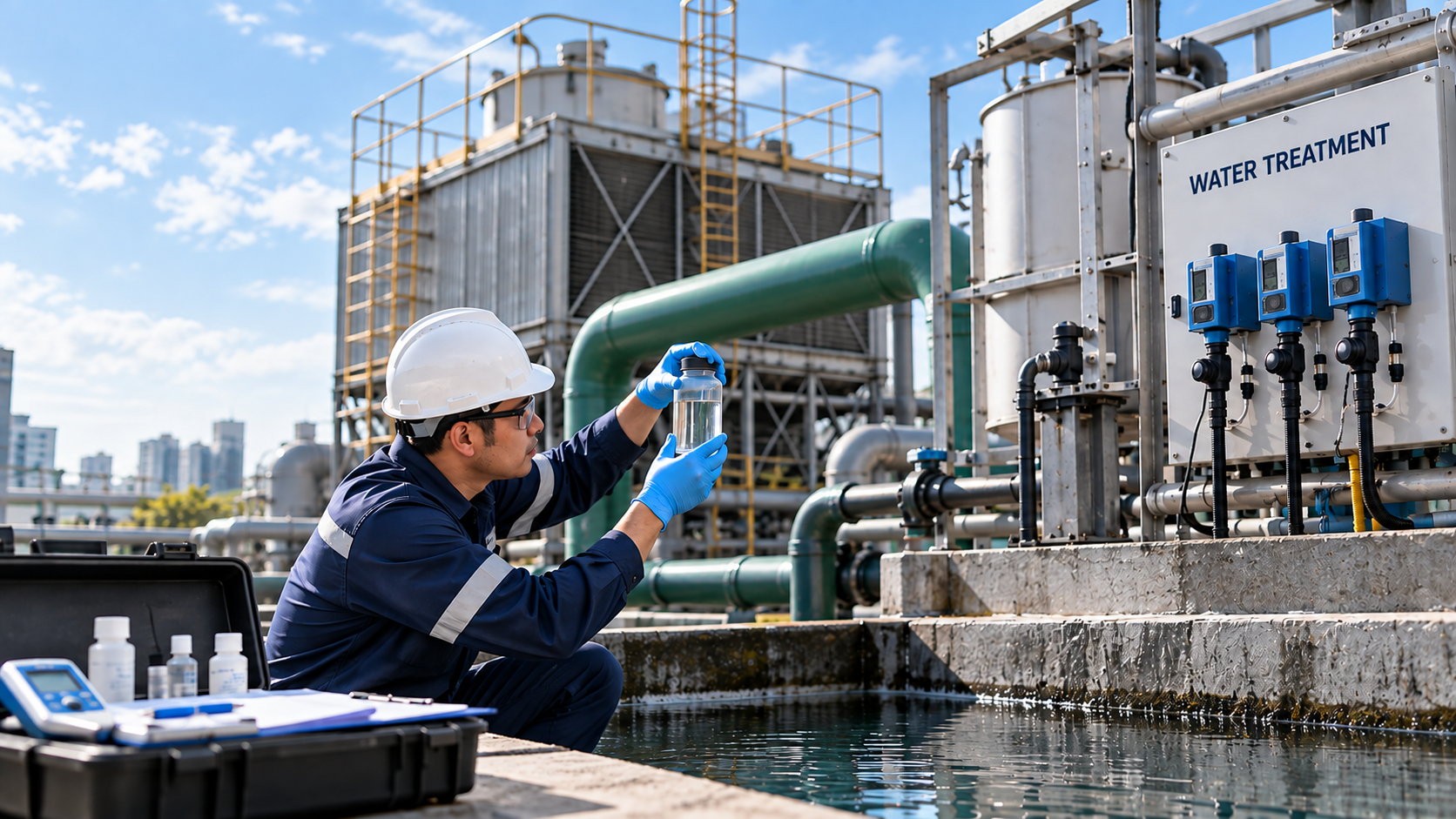
Cooling Tower Water Treatment in Malaysia: Why Chemical Dosing Alone Is Not Enough
When cooling tower water treatment is discussed, chemical dosing is often the first thing that comes to mind. Scale inhibitors, corrosion inhibitors and biocides all play important roles in protecting a cooling-water system.
However, adding chemicals is only one part of an effective treatment programme.Water conditions can change as a cooling tower operates. Without suitable testing and monitoring, facility teams may not know whether the treatment programme remains appropriate for the actual condition of the circulating water. For Malaysian industrial and commercial facilities, cooling tower water treatment should therefore be viewed as an ongoing water-management process—not simply a chemical-dosing task.
Why Do Cooling Towers Need Water Treatment?
Cooling towers continuously recirculate water while rejecting heat through evaporation. As water evaporates, dissolved minerals and other substances remain in the system and can become increasingly concentrated.
Without appropriate control, these conditions can contribute to problems such as scale formation, corrosion, fouling and microbiological growth.
Scale can accumulate on heat-transfer surfaces, while corrosive conditions may affect piping, condensers and other metallic components. Biological activity can also contribute to slime and biofilm within the cooling-water system.
This is why an effective cooling tower water treatment in Malaysia programme involves more than simply adding one treatment chemical. Depending on the system and water conditions, a programme may include scale control, corrosion inhibition, microbiological control, chemical dosing, monitoring and water testing.
What Problems Is Cooling Tower Water Treatment Trying to Control?
An effective treatment programme needs to consider several interacting water-quality issues rather than focusing on a single problem.
Scale Formation
As water evaporates, dissolved minerals become more concentrated. Under certain conditions, these minerals can form deposits on heat-transfer surfaces and other parts of the system.
Scale is not simply a cleanliness issue. Deposits on heat-transfer surfaces can interfere with efficient heat exchange, making scale control an important part of cooling-water management.
Corrosion
Water chemistry can also affect metal surfaces throughout a cooling system.
Poorly controlled conditions may contribute to corrosion in piping, heat exchangers, condensers and other components. This is why corrosion control needs to consider both the water chemistry and the materials used within the system.
Microbiological Growth
Cooling towers can provide conditions that support bacteria, algae and biofilm if microbiological growth is not adequately controlled.
Microbiological control should therefore be considered alongside water chemistry, system cleanliness and the overall treatment programme.
Fouling
Suspended solids, biological material and other deposits can contribute to fouling.
Rather than treating each issue in isolation, facility teams should consider how scale, corrosion, microbiological activity and fouling interact within the overall cooling-water system.
Why Isn't Chemical Dosing Alone Enough?
Chemical treatment is important, but adding a predetermined amount of chemical does not automatically tell an operator whether the water condition is under control.
Cooling towers are dynamic systems.
Make-up water quality, evaporation, blowdown, operating load and other conditions can influence circulating-water chemistry. A treatment programme therefore needs to respond to the actual condition of the system.
This is where monitoring becomes important.
The U.S. Department of Energy’s cooling tower management guidance recommends monitoring factors such as conductivity and water flows, maintaining records and observing trends in system performance.
What Water Conditions Should Cooling Tower Operators Monitor?
There is no single water-quality number that describes the condition of every cooling tower.
Different facilities may have different make-up water, operating conditions, system materials and treatment objectives. This means water-quality parameters should be interpreted as part of the overall system rather than treated as isolated numbers.
Several parameters, however, can provide useful information.
pH
pH describes how acidic or alkaline the water is.
It can influence scale formation, corrosion behaviour and the performance of certain treatment chemicals. Rather than evaluating pH alone, operators should consider it together with the rest of the water chemistry.
Conductivity
Conductivity provides an indication of dissolved ionic material in the water and is commonly monitored in cooling-water management.
It can also help operators understand how concentrated the circulating water has become compared with the make-up water.
The U.S. EPA’s guidance on cooling-tower water management discusses conductivity as one of the parameters used when managing cooling-tower water and cycles of concentration.
Hardness and Alkalinity
Hardness and alkalinity can provide useful information when evaluating scale potential and overall water chemistry.
Their significance depends on factors such as make-up water quality, system conditions and the treatment programme, so they should not be interpreted independently.
Microbiological Activity
Monitoring microbiological conditions can help determine whether biological growth is being adequately controlled.
If excessive biological activity is detected, the appropriate response should involve understanding the cause and reviewing the treatment programme rather than simply increasing chemical dosage without analysis.
Treatment-Chemical Levels
Where corrosion inhibitors, biocides or other treatment chemicals are used, appropriate testing can help determine whether treatment remains within the programme established for the system.
The important point is that monitoring creates information. Chemical dosing without feedback gives operators much less insight into what is actually happening inside the system.
What Can Water Testing Tell You About Treatment Performance?
Water testing turns treatment from assumption into measurable information.
Instead of assuming that a cooling tower is protected because chemicals have been added, testing allows facility teams and water-treatment specialists to evaluate the actual condition of the water.
Depending on the system and treatment programme, results may help identify changes in conductivity, hardness, alkalinity, microbiological activity and other relevant parameters.
Trends are particularly useful.
One unusual result may require investigation, while a pattern developing over time may indicate that water conditions, system operation or treatment performance have changed.
Testing can therefore support better decisions about chemical dosing, blowdown management, treatment adjustment and further system inspection.
For facilities that require more detailed analysis, Insignia Water also provides water testing and measurement services for industrial water-management applications.
Why Do Blowdown and Cycles of Concentration Matter?
Cooling-tower water management also involves balancing water efficiency with water chemistry.
As water evaporates, dissolved substances remain behind and become more concentrated. To manage this concentration, part of the circulating water is discharged as blowdown and replaced with fresh make-up water.
However, the balance matters.
Excessive blowdown can increase water consumption, while insufficient control of dissolved solids may contribute to water-quality problems.
This is where cycles of concentration become useful.
In simple terms, cycles of concentration indicate how concentrated the circulating cooling water has become compared with the make-up water.
The U.S. EPA’s cooling-tower guidance explains that conductivity measurements can be used as part of assessing cycles of concentration and managing cooling-tower water.
For facility teams, the objective should not simply be to achieve the highest possible number of cycles.
Instead, the operating approach should balance water efficiency with suitable control of scale, corrosion and other water-quality risks.
When Should a Cooling Tower Treatment Programme Be Reviewed?
A treatment programme should not be designed once and then ignored indefinitely.
A review may be appropriate when:
- water-testing trends change
- make-up water quality changes
- operating conditions or system loads change
- signs of scale, corrosion or fouling appear
- microbiological control becomes difficult
- equipment or water-use patterns change
Keeping records makes these changes easier to identify.
The U.S. Department of Energy recommends maintaining information on factors such as make-up water, blowdown, conductivity and cycles of concentration so that operators can observe system performance over time.
This means monitoring is not only useful when something has already gone wrong.
It can also help facility teams identify changing conditions and decide when further investigation or treatment adjustment may be necessary.
What Should Malaysian Facilities Look for in a Cooling Tower Water Treatment Programme?
An effective programme should begin with understanding the cooling-water system rather than immediately selecting a chemical.
Plant and engineering teams should consider:
- make-up water quality
- system operating conditions
- scale and corrosion risks
- microbiological control
- appropriate treatment-chemical selection
- dosing and blowdown management
- water testing and monitoring
- record keeping
- periodic programme review
The appropriate approach will vary between facilities.
A continuously operating manufacturing plant, for example, may have different cooling-water conditions from a commercial building with changing cooling loads. Water characteristics may also vary between sites.
For this reason, cooling tower water treatment should be based on the actual system and water conditions rather than assuming that one standard chemical programme will suit every application.
Facilities looking for an integrated approach covering chemical treatment, water analysis, dosing, monitoring and system optimisation can learn more about Insignia Water’s cooling tower and chiller water treatment solutions.
Effective Cooling Tower Water Treatment Is a Process, Not Just a Product
Chemical treatment remains an important part of cooling-tower management, but the chemical itself is not the entire programme.
Effective water treatment requires facility teams to understand what is happening in the water, monitor relevant conditions, observe trends and review the treatment programme when those conditions change.
For Malaysian industrial and commercial facilities, this broader approach can support better management of scale, corrosion, microbiological growth and water use.
Frequently Asked Questions (FAQs)
Do cooling towers need water treatment?
Cooling towers generally require appropriate water management because evaporation concentrates dissolved substances in the circulating water. Depending on the system conditions, treatment may be required to manage scale, corrosion, fouling and microbiological growth.
How is cooling tower water treated?
Treatment depends on the water chemistry and operating conditions of the system. A programme may include scale and corrosion control, microbiological treatment, chemical dosing, blowdown management, water testing and ongoing monitoring.
What chemicals are used in cooling tower water treatment?
Cooling-water programmes may use scale inhibitors, corrosion inhibitors, biocides and other treatment chemicals depending on system requirements. The appropriate chemical programme should be selected according to actual water and operating conditions rather than applying the same treatment to every cooling tower.
What should be monitored in cooling tower water?
Relevant parameters may include pH, conductivity, hardness, alkalinity, microbiological conditions and treatment-chemical levels. The parameters and acceptable operating ranges depend on factors such as make-up water quality, system materials and the treatment programme.
Is chemical dosing enough for cooling tower water treatment?
Chemical dosing can be an important part of a treatment programme, but it should be supported by appropriate water testing, monitoring and programme review. These activities help determine whether treatment remains suitable as water and operating conditions change.
Need Expert Guidance on Cooling Tower Water Treatment?
Effective cooling tower water treatment goes beyond chemical dosing. Insignia Water provides integrated water treatment solutions for industrial facilities in Malaysia, including water analysis, treatment chemicals, dosing, monitoring and system optimisation.
Whether you’re managing scale, corrosion, microbiological growth or changing water conditions, our team can help assess your system and recommend a treatment approach based on your operational needs.